
VRF HVAC vs VAV HVAC System Guide
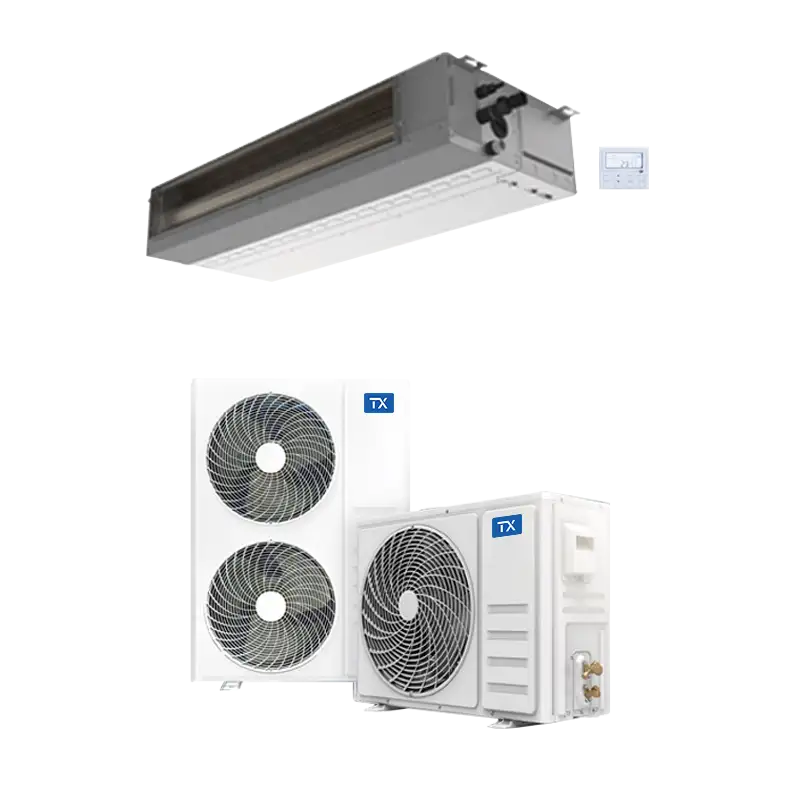
What is a VAV HVAC System?
A VAV (Variable Air Volume) HVAC system is an air-conditioning system that regulates airflow to meet varying room loads.
- VAV meaning in HVAC: Adjusting airflow rather than temperature to satisfy different room requirements.
- Core principle: Central air handling unit conditions the air → delivered through ductwork → VAV boxes in each room adjust the air volume.
- Advantages:
- Lower energy consumption than constant volume systems.
- Individual zone control.
- Suitable for large offices, schools, hospitals, or other centralized cooling/heating buildings.
- Disadvantages:
- Dependent on ductwork, which increases construction complexity.
- Limited flexibility under extreme load variations.
Therefore, variable air volume hvac system is widely adopted in modern centralized AC systems, especially in North America and Asia.
What is a VRF HVAC System?
A VRF (Variable Refrigerant Flow) HVAC system controls the refrigerant flow directly to meet varying temperature requirements across zones.
- VRF meaning in HVAC: Adjusting refrigerant flow rather than air volume to meet different zone demands.
- Core principle: One or multiple outdoor units → multiple indoor units → precise cooling/heating through refrigerant piping network.
- Advantages of VRF HVAC systems:
- High energy efficiency and flexible operation.
- Precise temperature control per zone; simultaneous heating and cooling possible.
- Less ductwork; ideal for space-saving installations.
- Disadvantages:
- Higher initial investment.
- Requires professional maintenance.
When asked what is vrf hvac or what does vrf stand for in hvac, the answer is a variable refrigerant flow hvac system, a high-efficiency, flexible system controlled by refrigerant flow.
How a VRF system works
A vrf system hvac uses an inverter-driven compressor to vary refrigerant flow according to room loads. Indoor units call for capacity, and the outdoor unit and branch devices meter refrigerant accordingly, avoiding energy loss from frequent on/off cycling.
Heat Pump vs Heat Recovery
- Heat Pump VRF — all connected indoor units operate in heating or cooling mode simultaneously; suitable for small to medium buildings with similar load profiles.
- Heat Recovery VRF — different zones can heat and cool simultaneously, internally transferring energy; ideal for hotels, hospitals, and mixed-use buildings.
Air-Source vs Water-Source
Air-source VRF exchanges heat directly with outside air (most common). Water-source VRF connects to a water loop, cooling tower, or geothermal system, often chosen for large campuses or high-rise retrofits where rooftop space or acoustics are limited.
VRF vs VAV HVAC System Differences
- Medium: VAV uses airflow; VRF uses refrigerant flow.
- Flexibility: VAV limited by central fan and ducts; VRF allows individual zone control.
- Energy Efficiency: VRF HVAC system is more efficient, especially at partial loads; VAV is energy-saving but less efficient than VRF.
- Applications: VAV suited for large centralized buildings; VRF ideal for mid-to-small offices, hotels, and apartments.
Comparison Table: VRF vs VAV
| Feature | VAV HVAC System | VRF HVAC System |
|---|---|---|
| Full Name | Variable Air Volume HVAC System | Variable Refrigerant Flow HVAC System |
| Medium | Airflow | Refrigerant Flow |
| Flexibility | Medium | High |
| Energy Efficiency | Good | Excellent |
| Applications | Large buildings (schools, hospitals, offices) | Mid-to-small buildings (hotels, apartments, offices) |
| Initial Cost | Relatively Low | High |
Which System is Right for Your Project?
Choosing between a HVAC VAV system and a HVAC VRF system depends on:
- Building Size: Large centralized cooling → VAV; multiple dispersed zones → VRF.
- Budget: Limited → VAV; long-term energy savings and comfort → VRF.
- Maintenance: VAV is mature and easier to maintain; VRF requires professional service.
For example, a hospital may favor VAV, while a boutique hotel may benefit from VRF.
FAQ
- Q1: What is VRF in HVAC? A: VRF stands for Variable Refrigerant Flow HVAC system.
- Q2: What is the meaning of VRF in HVAC? A: It refers to a system that adjusts temperature through varying refrigerant flow.
- Q3: HVAC VAV definition? A: Variable Air Volume (VAV) HVAC system, adjusts airflow per zone to meet load requirements.
- Q4: Which system is more energy-efficient? A: Generally, VRF HVAC system is more efficient than VAV HVAC.
Conclusion
In HVAC technology, VAV HVAC system and VRF HVAC system each have advantages and limitations.
- Focus on upfront cost and centralized cooling → VAV is suitable.
- Pursue comfort, flexibility, and long-term energy savings → VRF is preferable.
Understanding VRF HVAC meaning and VAV meaning HVAC helps make informed decisions. You can visit Tongxing to learn more about HVAC technology, or read this introduction to HVAC.
